
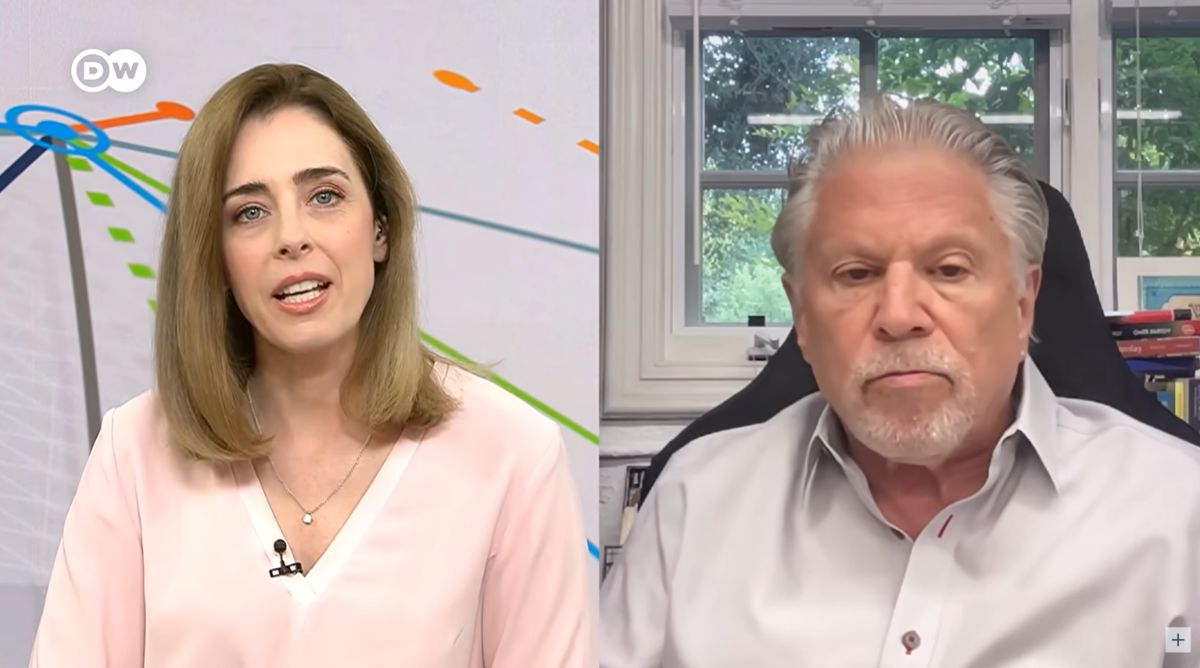
Panelists
- Interviewer, DW program host
- Jonathan Jacoby, President of the Nexus Project
Details
- Date: September 18, 2026
Hosted by DW News (Deutsche Welle)
Transcript
Recorded Live — Full Session
Interviewer: We’re joined by Jonathan Jacoby, president of the Nexus Project. The Nexus Project is made up of individuals deeply committed to the fight against anti-semitism and also to the fight to uphold pluralistic democracy. Welcome to the program, and thank you for joining us. Much of the focus of your work is on distinguishing anti-semitism from criticism of Israel. You’ve previously said that Macklemore’s most recent advocacy for Palestine may be uncomfortable, but it isn’t necessarily anti-semitism or hate speech. Could you explain why you think that’s the case?
Jonathan Jacoby: Well, I think first of all, shutting down Macklemore doesn’t help us confront anti-semitism, especially when he went out of his way to distinguish his criticism of Israel from criticism of the Jewish people. I think it’s pretty easy most of the time to understand when something is or isn’t anti-semitic.
You just have to ask four questions. Does it use an anti-semitic trope? Does it deny Jews the same rights as it affords Palestinians, whether individual or national? Does it assign Jews collective responsibility for Israel’s actions? Does it advocate or lead to violence against Jews? None of what Macklemore said meets those criteria. So I wouldn’t call it anti-semitic. And when you call it anti-semitic, you shut down the conversation about the actual issue.
Interviewer: Robert Kraft, in the meantime — and I’d like to just run through what he has said here, just to give the backstory to our viewers. This is the billionaire owner of the New England Patriots. He has said that the decision to cancel Macklemore was the result of the rapper’s recent comments as well as a broader history of what Kraft described, and I’m quoting him here, as anti-Semitic rhetoric and imagery.
The backstory is that in 2014, Macklemore appeared at a performance wearing a large prosthetic nose, a dark wig, a fake beard, and dark clothing. Critics said that this combination resembled a long-standing anti-semitic character of a Jewish man, and Macklemore subsequently apologized. Robert Kraft’s venue is private. When you take all of this history together, what standard do you think a private venue and a private owner should apply when deciding that an artist’s expression has crossed the line, potentially into hate speech?
Jonathan Jacoby: So, first of all, I think that the fact that Robert Kraft is a billionaire is irrelevant to the conversation. He is the owner of this particular stadium. And whether or not it’s a private stadium or a publicly owned venue, it is a public venue. It is a place where tens of thousands of people show up to celebrate sports teams and to celebrate music. And so I don’t think it’s relevant that it’s private or public. And I think that Kraft has a responsibility as a public figure to be more thoughtful. Robert Kraft is a thoughtful man.
I think he had another option. What if he had invited Macklemore to his office to see if they could find common ground? What if he had said to Macklemore — which he said in a statement — that he did not want to diminish the suffering of innocent Palestinians or deny anyone the right to advocate on their behalf? That was an opportunity for education. Canceling the show cancelled that opportunity.
Interviewer: For context, we also have to mention that the Anti-Defamation League has also leveled criticism against Macklemore as well.
What do you think this controversy — because this has clearly struck such a chord — has revealed about the state of conversation on Israel and Palestine that goes beyond Macklemore himself?
Jonathan Jacoby: Well, it’s very unfortunate that the conversation about Israel and Palestine, which is a really important conversation, is being toxified by these accusations of anti-semitism. Sometimes there really is anti-semitism, and that anti-semitism needs to be addressed. But most of the time what we are seeing is legitimate criticism of Israel — criticism which, as I’ve said, can make people uncomfortable, and makes me uncomfortable. But the first response shouldn’t be to get into the muck of anti-semitism. The first response should be to have a conversation. And that toxification is getting in the way of that conversation, and it’s leading to more polarization.
Interviewer: When we talk about this conversation, what responsibility do you think Macklemore himself has to understand why some Jewish listeners hear his rhetoric or imagery differently from how he says he intends it?
Jonathan Jacoby: Right. I wish Macklemore would be more proactive in making clear, for example, that he’s not talking about Jewish people. I’d like Macklemore to be more thoughtful about how he talks about not just the rights of the Palestinian people, but the rights and the issues confronting Jews, and Jews in Israel. I think he could do that better.
Interviewer: Okay, Jonathan Jacoby, we want to thank you so much for joining us to break some of this down for us. A sensitive topic, as we mentioned, and we appreciate you joining us here on DW to share your views.
Jonathan Jacoby: My pleasure. Thanks for the opportunity.
