How To Talk About The “Jewish Vote” Without Falling Into Antisemitic Tropes

Here’s our guide to talking about the “Jewish vote” in the 2026 midterm election without falling into antisemitic ‘dual loyalty’ tropes.

Every election season, the “Jewish vote” is examined, parsed, and written about at length. The 2026 midterms are no exception, and increased attention to the US-Israel relationship has meant even more conversations about Jewish voter behavior and attitudes.

Looking at data and patterns is not antisemitic. But using that data to attack Jews as disloyal to America or paid servants of Israel is.

Let’s look at where commentary becomes conspiracy and lines are crossed.

First off, what is the “dual loyalty” or “disloyalty” trope?

“Dual loyalty” is the insinuation that Jews pledge allegiance to Israel, or a global Jewish entity, rather than the country they live in. It has been used for centuries to paint Jewish communities as threats to a nation’s culture or power, implying they can’t be trusted and should be excluded from political participation.

Explaining away the trope

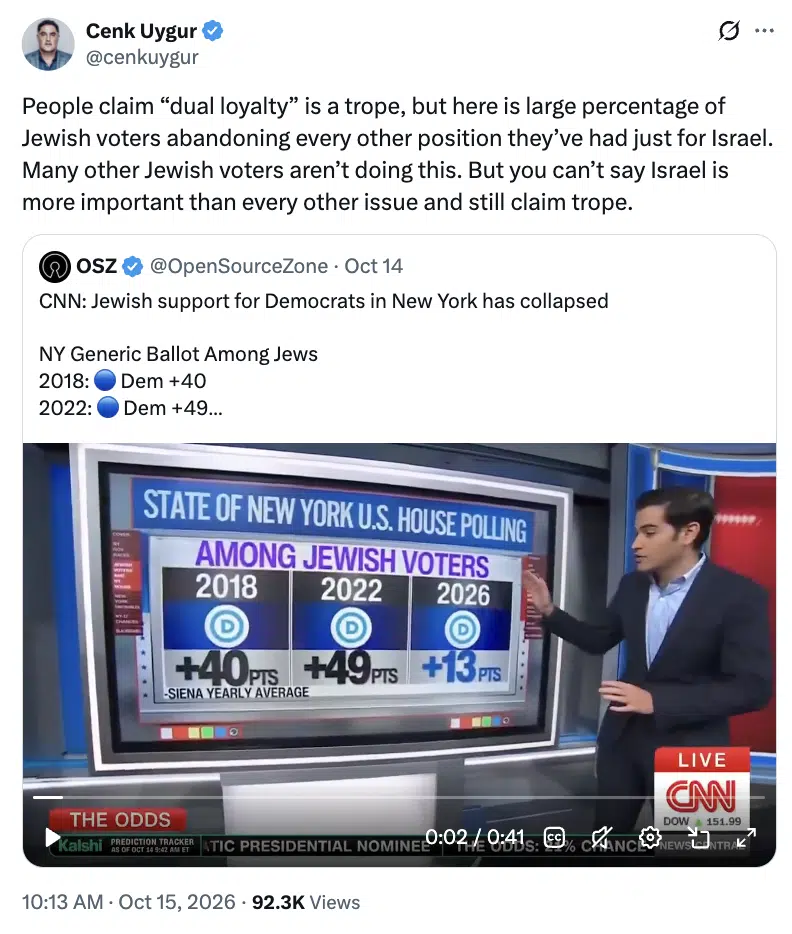
Post on X by Cenk Uygur, October 15, 2026: “People claim ‘dual loyalty’ is a trope, but here is large percentage of Jewish voters abandoning every other position they’ve had just for Israel. Many other Jewish voters aren’t doing this. But you can’t say Israel is more important than every other issue and still claim trope.” It quotes a CNN clip on New York House polling among Jewish voters: Democrats +40 in 2018, +49 in 2022 and +13 in 2026.
Attempts to explain away the trope (like this tweet) show why it’s so important to understand the history and reasoning behind it.

What’s the history of it?

The dual loyalty trope predates Israel’s formation by centuries, drawing on age-old suspicions of Jews as traitorous, perpetual outsiders.

One of history’s most notorious examples is the Dreyfus Affair. In 1894, Alfred Dreyfus, one of the few Jewish officers high up in the French army, was falsely accused of treason and espionage. At a time when antisemitism was surging in France, the case rested on the notion that a Jew could not be trusted to put France first. When proof of his innocence surfaced, the army suppressed it rather than admit the error. In 1898, Émile Zola’s open letter “J’Accuse…!” accused the army of a cover-up and ignited a national controversy that split France into two camps: Dreyfusards, who demanded justice for Dreyfus, and anti-Dreyfusards, who defended the army and often cast Jews as a foreign presence within the nation.

How is it used today?

Today, the trope most often takes the form of claims that Jewish citizens are more loyal to Israel than to their own country. It shows up regularly across the political spectrum.

Accusing Jewish American candidates and elected officials of having allegiance to Israel or of being “Israel’s puppet” or “bought and paid for by Netanyahu” plays right into the trope. Criticizing a candidate’s Israel policy or AIPAC funding is fair game — questioning a Jewish candidate or elected official’s loyalty or applying a certain litmus test to them solely because they are Jewish is when it becomes an antisemitic trope.

What about President Trump accusing Jewish Americans who vote Democrat of being “disloyal”?

That’s definitely the dual loyalty trope. While most people invoke dual loyalty to turn others against Jews, Trump invokes it in an attempt to garner support from Jews. It’s still antisemitism.

In 2019, Trump said that Jews who vote for Democrats are “very disloyal to Jewish people.” Then in March 2024, he doubled down on his comments, stating that “any Jewish person that votes for Democrats hates their religion.” And in July of this year, he once again called out Jewish people who vote Democrat (an estimated 69% of Jewish American voters, according to a 2024 Pew poll), claiming he’s been the “best president in Israel.” And just this month, Trump claimed any Jews who vote for Abdul El-Sayed should be “ashamed” and that “You should never speak to them again.”

Not only does Trump assign Jewish Americans a certain relationship to Israel (i.e., dual loyalty), but he’s also saying Jews have to support a particular politician to prove their loyalty or even be accepted in their own communities.

“But my Jewish friend’s dad says he’s a single-issue voter, and that issue is Israel.”

Of course some Jewish Americans vote with Israel top of mind. But Jewish Americans are not a monolith. As with any large group, the voting preferences differ widely across the board. In the Jewish Voters Resource Center’s 2026 poll of 800 Jewish voters, 71% said they were emotionally attached to Israel, but only 16% ranked Israel among their top-two voting issues. Their actual top priorities? Affordability (37%), the future of democracy (36%), antisemitism (25%), and healthcare (18%). Israel came in fifth as a top-two Jewish voter issue.

You may disagree with the 16% of Jewish American voters who consider Israel a top-two issue as an American, but voters are entitled to pick any range of issues to have at front of mind when they go to the polls — it doesn’t make them less American.

Only 16% of Jewish voters ranked Israel among their top-two issues. Israel came in fifth.

Nexus bar chart: 800 self-identified Jewish voters were asked which two issues are most important in deciding their November 2026 vote. Cost of living 37%, future of democracy 36%, antisemitism 25%, healthcare 18%, Israel 16%. Full data in the text version below.
Source: Jewish Voters Resource Center’s Sept. 2026 National Poll of Jewish Voters.
Text version of this chart
Top-two voting issues, November 2026 election (800 Jewish voters)
IssueShare
Cost of living/affordability37%
The future of democracy36%
Antisemitism25%
Healthcare18%
Israel16%
Corruption14%
ICE deployment in US cities12%
National security/foreign policy11%
Social Security/Medicare8%
Immigration5%
Iran war5%
Abortion4%
Guns2%
Other5%

What’s the real-world impact?

The effect is to push Jews out of political participation by making their Jewishness a liability, whether or not that’s the intent.

In addition, Jewish dual loyalty accusations also manifest in a unique way relative to other communities: they are often combined with the claims that Israel controls the United States. This creates a dynamic whereby diaspora Jews are implicated in this supposed control, and thus are also considered part of the conspiracy to control the government.

This is one of the many ways that lead to justification to jump from conspiracy theories about Israel to full-on conspiracy theories about all Jews.

Nexus graphic titled “So where is the line?” comparing four “fair game” examples with four “red flag” examples. Full text in the text version below.
Text version of this graphic
So where is the line?
Fair gameRed flag
Criticizing the Israel policies/endorsements of a candidate, lobbying group, or donor networkAssuming Jewish voters or candidates answer to Israel because they’re Jewish
Talking about the latest poll on Jewish American votersImplying Jewish Americans cannot be trusted because of their connection to or position on Israel
Reporting on how Jewish voters rank the issuesAssuming that Jewish voters only care about Israel
Asking any candidate where they stand on Israel, the way you would on any foreign policy issueApplying a litmus test to Jewish Americans, such as demanding that they prove their loyalty by denouncing or defending Israel

And remember: Jewish Americans are far from the only group facing allegiance accusations.

Just look at the false claims about Muslim Americans trying to impose Sharia Law in the U.S., or false claims about Muslim American ties to the Muslim Brotherhood. Just this month, Abdul El-Sayed — who, if elected, would be the first Muslim U.S. Senator — was asked to “disavow” the Muslim Brotherhood by a heckler who turned out to be a former staffer for Senator Josh Hawley. New York City Mayor Zohran Mamdani frequently faces questions about his loyalties, including this ad from the Canary Mission.

Example of a loyalty accusation

Post on X by Canary Mission, November 2, 2025: “When a candidate releases an ad, nothing is random. Zohran Mamdani’s latest video targeted to the Arabic-speaking community tells you exactly where his priorities lie - and it’s not NYC.” The attached video shows Mamdani on a city street at night, subtitled in Arabic and English: “Hello! My name is Zohran Mamdani.”
A Canary Mission post questioning Mayor Mamdani’s priorities.

The strategy is the same: question their loyalty in order to remove them from participating in politics.

It’s on all of us to combat loyalty accusations whenever they surface, no matter whom they target.

Share This Page