
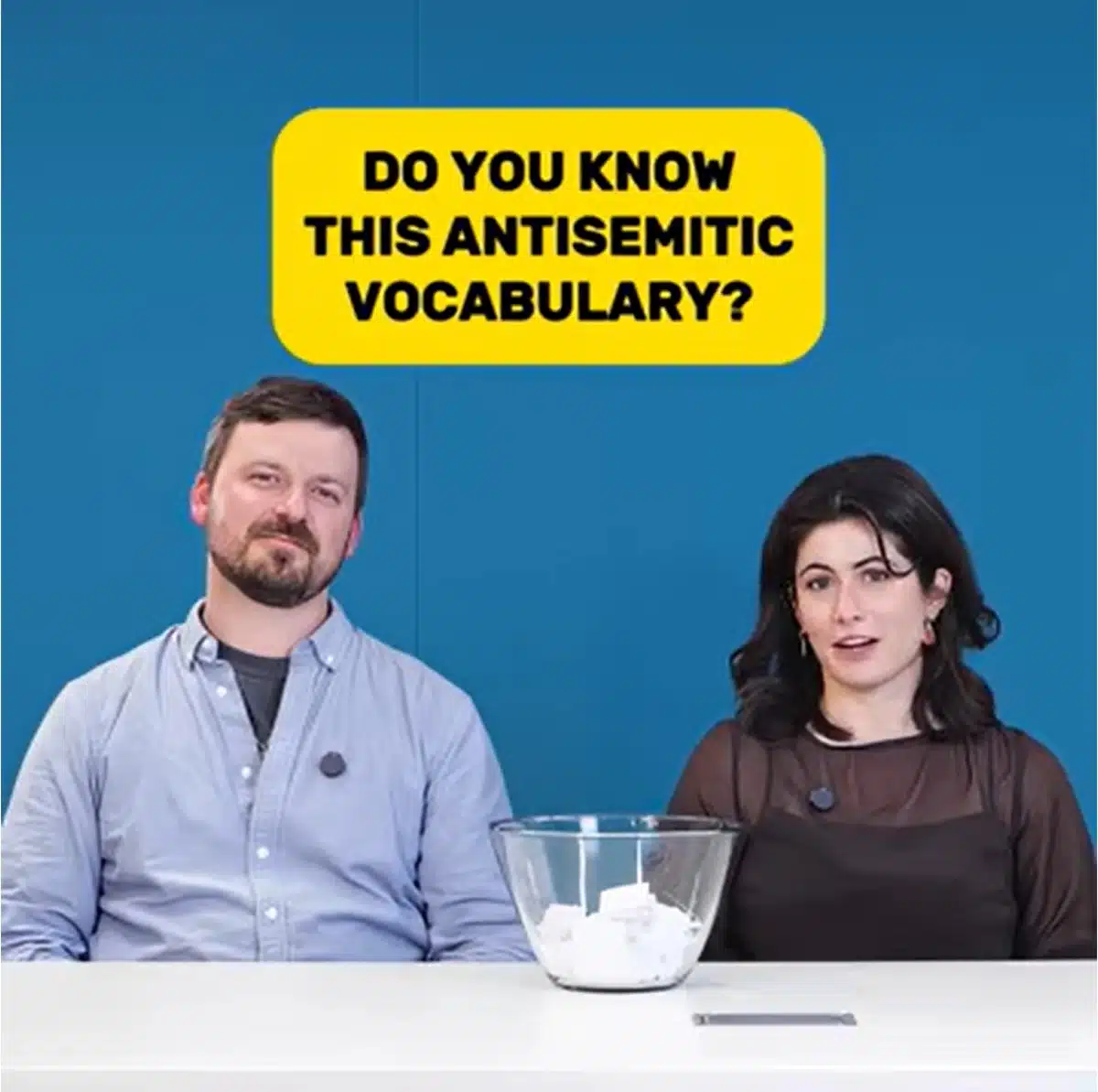
We gathered some of the most complicated and controversial terms in conversations about antisemitism and put Nexus Project to the test.
Experts
- Nate Wolfson, Communications Director
- Ella Messler, Executive Associate
Details
- Date: October 7, 2026
Hosted by J Street
Transcript
Recorded Live — Full Session
Ella Messler: How well do you actually know the vocabulary around anti-Semitism?
Nate Wolfson: We’re putting ourselves to the test. Starting with a big one: the Great Replacement theory. This is the theory that Jews are organizing a mass replacement of white people in America by orchestrating these big influxes of immigrants to the country.
Ella Messler: It’s also a really great example of the way that anti-Semitic tropes can also target other communities. So, for example, targeting immigrant communities or targeting trans people.
Nate Wolfson: Let’s see what we’ve got here. Scapegoat. Basically pointing to one group of people, or type of person, or a singular person as the cause of a specific problem, and then violence is perpetrated against them as a result.
Ella Messler: Anti-Semitism fatigue. Using a plethora of examples of anti-Semitism happening all the time to be desensitized to it and to then dismiss it. So, “There’s so much anti-Semitism happening, I can’t deal with it. It’s not really a problem, because there’s just too much to deal with.”
Anti-Semitism fatigue can also represent people who experience anti-Semitism themselves and then get really, understandably exhausted by the hate that they’re experiencing.
Nate Wolfson: There are a lot of Jews I know who practice less, as well as people who maybe don’t want to wear a chai anymore, or don’t want to wear a kippah anymore, because they’re just so sick of dealing with the anti-Semitism that comes with those things. Which in some ways is the point and the goal of anti-Semites.
Coded language. This is one that I follow very, very closely as someone who is entirely too online. These are basically ways to skirt content filters on social media, and also a way of giving yourself plausible deniability. Because if you say you hate globalists, you’re not saying you hate Jews, but you’re kind of saying you hate Jews. A juice box emoji is how people say “Jews” on the internet. Or 88, which is “Heil Hitler.” H is the eighth letter of the alphabet.
Ella Messler: Think things like the nose emoji, or two lightning bolts to represent the SS bolts.
Nate Wolfson: A proxy target. This is a way that, when Jews are scapegoated, it can lead to violence against the community as a proxy for what people are actually mad about.
Ella Messler: Holocaust denial. The denial that the Holocaust happened. There are also some other forms that Holocaust denial can take, like minimization, equalization, distortion.
Nate Wolfson: There’s a big viral claim of 271,000, at best. The goal is basically just to undermine the public record.
Ella Messler: You can also see Holocaust denial in some dog whistles. So things like “6MWE,” which stands for “6 million wasn’t enough.” That’s a dog whistle example of Holocaust denial.
Zio. This is a pejorative shorthand for Zionist. Even though it seems like it’s just short for Zionist, this was a term popularized by David Duke, who is the former Grand Wizard of the KKK. This is kind of an aim to turn “Zionist” into a slur, and to be able to refer to Jews and talk about Jews without them knowing that “we’re talking about them.”
Nate Wolfson: Globalists. This goes to this idea of global control of the economy. And who would be at the top of that, according to the people who use this pejoratively? The Jews. So this is a term that you’ll often see in place of “Jews.” Another reason a lot of these words are used is that someone who may not agree with your point if you outright say “Jews” may agree with your point more if you say “globalists,” and then you’ve brought them into the anti-Semitic pipeline.
A dog whistle. A dog whistle, in its literal sense, is a whistle that only dogs can hear. And so a dog whistle, in the anti-Semitic sense, is a term that is supposed to only activate and be understood by fellow anti-Semites. It’s a way of recruiting in public, in the open, without other people knowing what you’re doing. This is specifically for the subtle recruitment tactic, and the subtle nods, the wink-and-nudge type of language that people use.
Ella Messler: Jewish control. This is the trope that Jews control media, politics, government, and on and on and on.
Nate Wolfson: The weather.
Ella Messler: The weather. This was really prevalent in Nazi Germany, of course, with puppet master rhetoric. So, claims that Jews control the American government to sway what happens in Israel.
Israel First. This is a trope that Jews care more about Israel than they do about America, or that Jews are more loyal to Israel than they are to America. You will see a lot of Jews vote in the interest of Israel because, as Jews, Israel is something that matters to them. But it’s really important to note that that’s not all Jews. And I would also add that it’s probably likely that’s not even most Jews in today’s America. So alleging that Jews only care about Israel, or that they care about Israel more than they care about America, is an anti-Semitic trope, and you should call it out.
Nate Wolfson: So this is obviously not an exhaustive list. Look how many more we have to go. Go ahead and check out nexusproject.us. We have full deep dives into a lot of these terms, how they’re deployed, and where they came from. Feel free to check us out.
