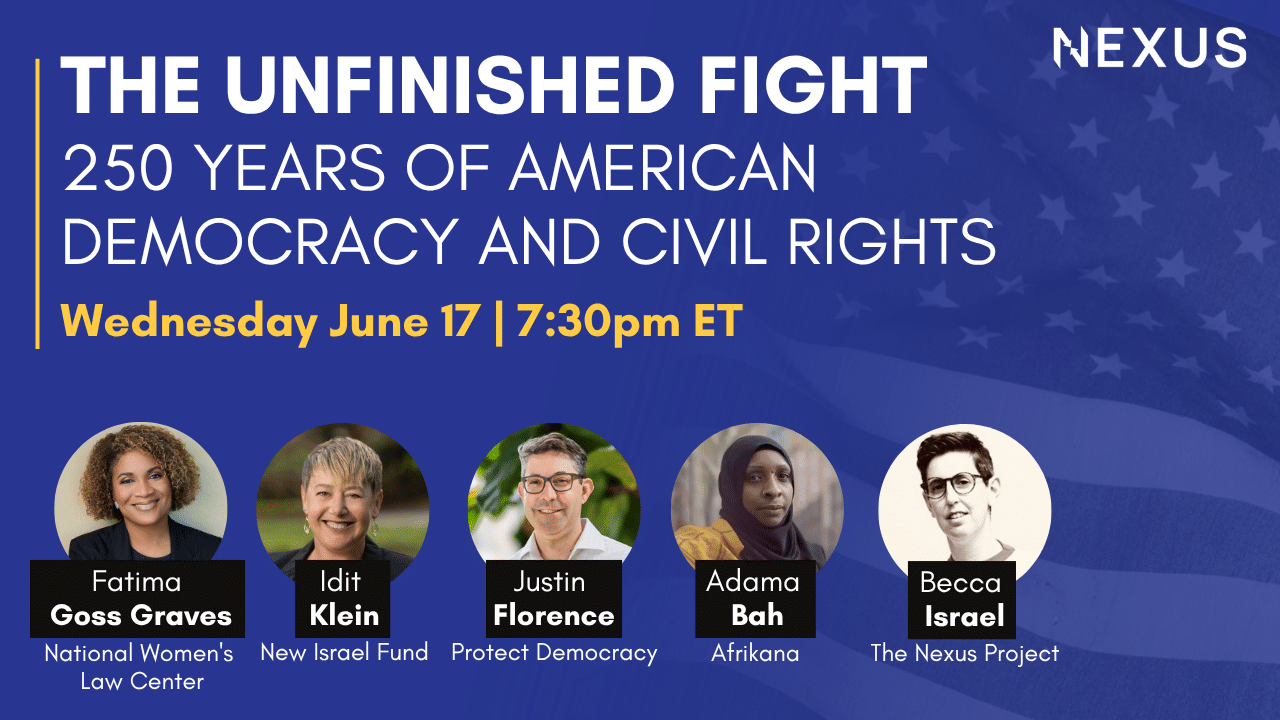
This event gathered leading voices to discuss what the next 250 years of American democracy could look like when we protect and strengthen our shared values.
Panelists
- Fatima Goss Graves, CEO of the National Women’s Law Center
- Idit Klein, Founding President and CEO of Keshet
- Justin Florence, Co-Founder and Senior Advisor of Protect Democracy
- Adama Bah, Founder and Executive Director of Afrikana.
Details
- Date: June 18, 2026
- Moderator: Becca Israel, Vice President of Philanthropy and Strategic Engagement for The Nexus Project
Hosted by The Nexus Project
Transcript
Recorded Live — Full Session
Becca Israel: Welcome everyone. Thank you again for joining us tonight for this important conversation. My name is Becca Israel, and I serve as the Vice President of Strategic Engagement and Philanthropy here at the Nexus Project. For those of you who are new to the Nexus Project, our work is built on a simple but powerful idea: the futures of American Jews and American democracy are deeply interconnected.
That’s the foundation of our mission. Combating anti-Semitism and its weaponization, defending free speech, and safeguarding our democratic institutions. Because as many of you know, protecting one means protecting the other. And our approach is unique, which is supported by experts, professional staff, and an academic task force of leading scholars, writers, and thought leaders, and the work is grounded in trusted data and rigorous research. Now, the gap that Nexus fills is that we bring this informed, expert approach to the public square.
So we’re equipping policymakers, journalists, educators, allies, and communal leaders with the tools to identify understand and address anti-Semitism and prevent our community’s fears from being used as a weapon to attack civil liberties. That sometimes even includes speaking out when fears of anti-Semitism are cynically exploited to stifle legitimate criticisms of Israeli or US policies. Now, I imagine the reason that you’re here tonight is because you understand that American democracy has been a lifeline for American Jews and for the communities that we have long been in partnership with.
My hope for you is that you walk away from this call feeling energized, inspired, and hopeful about the future of American democracy, and believing that a path forward is truly possible. And I hope you walk away knowing that Nexus can be your Jewish political home, an organization that believes in nuance, that refuses to further polarize and that won’t be in the business of deciding who is or isn’t part of our community.
Our work in Nexus and conversations like the one we are having tonight is not that. We all read the news, we all watch how politics takes over our social conversations, and many of us feel totally exhausted. But this is not that. This is an understanding that our future depends on us being bold.
On us recognizing that change is possible, and that the four leaders here tonight are some of the boldest out there. So tonight we’re privileged to be joined by Justin Florence, the co-founder and legal director of Protect Democracy, Fatima Goss Graves, the CEO of the National Women’s Law Center, Idit Klein, the Founding President and CEO of Keshet, and Adama Bah, the CEO and founder of Afrikana.
An in an effort to make this webinar run efficiently, which I love, we will not be doing a Q&A. Instead, we will hear from each speaker, followed by a quick closing. So without further ado, let’s jump into this. And I’m excited to introduce Justin Florence, the co-founder and legal director of Protect Democracy. Hi, Justin. Thank you so much for being with us today.
Justin Florence: Thanks for having me. It’s good to see you. So I’ll start with just an opening question, which is frankly, what drew you to this work? And how does your Jewish identity and professional identity of protecting voting rights shape the way that you approach the work?
I thought your opening really captured some of that. And I was reflecting before this on our national motto of e-pluribus unum, that out of many won. And felt that very resonant with my own Jewish identity. as folks know, the Jewish tradition constantly reminds us that we were once strangers in a strange land. and I take out of that a sort of universal commitment to protect the rights, the dignity, the ability to participate of everybody, and to try to build a society where that’s possible.
An of course, at the heart, that means a functioning democratic political system where folks can have a say and work alongside each other. And so they really do come together in that way.
Becca Israel: That’s amazing. and can you just share a little bit more for folks? Like what does protecting democracy actually look like on the ground? can you just share some like tangible examples of what that what that looks like for you at Protect Democracy.
Justin Florence: Yeah. So our organization is about 10 years old.
And we founded it with the recognition that there was a novel and unique threat to our democracy over the last decade or so, which is of a more authoritarian type threat than we’ve been used to seeing. for a long time, there have been weaknesses in our democracy, folks who have been left out, people whose rights have not been fully protected, et cetera. but across the globe, there’s been this real rise of authoritarians and the US has not been spared of that.
So that has involved a lot of situations where either the federal government or state actors or people working with them are either passing novel policies, taking unusual actions, committing to violence. And what we are trying to do is prevent that in all the ways we can. So some of that is about litigation. Our team has a significant number of lawyers and are in federal court all around the country.
Some of that is legislative strategies and trying to get both the US Congress and state legislatures to enact legislation that is more protective of checks and balances and voting rights and public participation. Some is kind of organizing it, speaking to folks and trying to bring all the tools we can to bear.
Becca Israel: And I know I said this is this is not gonna be a heavy call but an energizing call, but I would love if you could just share what’s what are some of the most concrete threats to democratic participation that you’re seeing right now?
An I’d especially love it if you could just walk us through the SAVE Act, what it does and why it matters.
Justin Florence: Sure. Let me put it all in some context. so I mentioned the authoritarian playbook.
And it’s a set of factors that these strong men use. They quash dissent, they aggrandize executive power, they stoke violence, they spread disinformation. We’re in an election year now, and a lot of those factors come together into an overarching effort to corrupt and override a free and fair election. And that is something new and different that we haven’t seen, where I think for the first time in US history, the Trump administration is wielding the full power of the government against our own elections, not simply to like try and influence people to vote a particular way, but to silence voices, to change the rules.
That election news, for folks who you know are watching the news, reading the paper, can get overwhelming. and so we put together a little framework to try and make sense of it all. we call it the three Ds: deceive, disrupt, deny. And so just to take a beat on each of those because they do sort of make sense of what’s happening. First piece of it is deceive, trying to use the power of government to convince as many Americans as possible that our elections are somehow unsound, insecure, there’s widespread fraud. and that creates the pretext to then get in and meddle with it.
Then there’s the disrupt piece, so using that pretext of election lies and conspiracy theories to change the rules, to threaten opponents to manipulate the playing field. The Save Act that you alled to Becca, I think, is a prime example of this. it’s not the only thing, but it’s one of many moves that we’re seeing to try and shape who is allowed to vote and how they’re allowed to participate.
So the Save Act is legislation pending in the US Congress. just to it seemed like it was dead. And just today, the president, if folks were following, said he was not going to put in place his proposed nominee lead the intelligence community in West Congress voted on the SAVE Act first, kind of a bizarre situation.
Why does he want this so much? it strips millions of Americans of the ability to vote. It creates these new processes where DHS and DOJ control voting roles when the way our country works, the way our laws work, these are controlled by states. Different states have different policies, but all have strong systems and procedures.
To make sure that only eligible folks can vote. and the analyses I’ve seen, if the Safe Act went through, something like 21 million Americans, 21 million might not have access to the types of documentation and requ and requirements to be able to vote. And those are folks who should be eligible under the law. so there’s the disrupt piece, and then when we just close it out with deny.
So if after all the efforts to kind of undo how the election is supposed to go the preferred candidates still lose, then it’s just deny the results and try to overthrow them. Either you pressure officials to ignore them or try and get Congress to reject folks, or ultimately, you know, as we saw on January 6th, turn to violence. So I know we will get to uplift. I’m sure my fellow panelists will bring some good uplift. I will try to as well, but there are real threats and it is scary times, not just sort of what our politics look like, but the kind of effort to like really tilt how the whole playing field works.
Becca Israel: Right. I mean, even certifying elections now is not even a given thing. so in contrast. You know, it used to be that the work of voting rights lawyers and activists was let’s make sure people can vote. And that’s our job. And now it is like, well, will those votes get counted?
Will the ballots get thrown away? Will they get seized by somebody? Will the results not be certified?
That’s really post-election work is where lots of us are spending time. That’s great and I feel like that’s such an important gap that you’re filling. so in contrast and on the hopeful note.
I’d like it if you could share as we look ahead to the next 250 years, like what is a full protected, what is fully protected voting access actually look like? And what would it mean for all of us if it were achieved?
Justin Florence: I love it. so there’s a bunch of stuff we can all be doing now in the like over the next few months to protect voting rights. and that’s a band-aid, but it can get us through. so everything from organizing in your communities and making sure you have a plan to vote and volunteering as a poll worker and building constituency power. over the long run, I think there’s a few things we can do, and I’ll name maybe three in particular. one is we need to reauthorize and update the Voting Rights Act.
This is the landmark piece of legislation that has been vital to protecting so many folks’ right to vote and equal representation. Of course the court has over many years now, the Roberts Court has chipped away at pieces and pieces of it, including in a in a really disastrous decision earlier this year. So we got to undo that is one.
Second thing is our constitution and our laws do not actually guarantee a right to vote. They say you can’t be discriminated against in voting, you have to be treated equally, but there is no actual right to vote. And Congress can pass one. It considered it as part of the Freedom to Vote Act and it should be a centerpiece of forward-going legislation to say, like everybody who is eligible under the rules has a right to vote and they have remedies to protect it.
Then the third thing I think we can do is update the way our electoral systems work. now that is a like maybe wonky term, but what it means is the method we use to translate our votes into how we are all represented in Congress and legislatures. Protect Democracy is a big enthusiast for moving toward proportional representation. And the way that would work is lots of different voices get to be heard.
And get to be represented. And so now in a lot of places, like if you look around the country, there are so few house districts that are actually competitive. So most people, their votes don’t matter at all.
Even the competitive places, you only get two choices. What if we move to a system where you could have lots of different choices? And you could have a party that advocated for your economic views or your climate views or your views about, you know, faith and religion and public life, whatever these are. And what I love about that is that I think it can help us achieve like two of the deepest values of our last 250 years or our sort of highest ideals. one is we are a democratic government, that form of government where representation is at the at the heart, like self-government because we get to vote on who represents us. and the other is where we started with e purbus unum with pluralism.
That we are we’re a big country with a lot of different communities and a lot of different viewpoints. And how can we make it so that all of those have a place and can be represented and work together? and I, you know, am fundamentally optimistic that as dark as the times we are in now, they can be a real springboard to big and significant reforms like these. And I’m very eager to hear what my co-panelists have in mind. but I think if we build from this moment,navigate the next few months, it can really chart us on a path towards a new political system that truly represents us and gives everybody a voice in our in our country.
Becca Israel: Thank you so much, Justin. I really appreciate that. Thank you. And and again, thank you to everybody who is here and very eager to hear from my colleagues on the panel. So next I’m gonna call in Fatima Goss Graves, who is the CEO of the National Women’s Law Center. and someone just I have personally looked up to for a long time. welcome, Fatima.
What we’re gonna do is we’re gonna move over to our next panelist and then come back to Fatima. So we’re gonna move over to Idit Klein, who is the Founding President and CEO of Keshet. Welcome, Idit.
Idit Klein: Thank you. I feel like we’re making a commercial for Zoom.
Becca Israel: Yeah, totally. Would it I think it would be a really great commercial actually? it’d be interesting for sure. It would go viral. Yeah. totally. It could really put Nexus on the map, you know.
Idit Klein: my god. Absolutely. it’s one of it’s actually it’s one of our strategic priorities right now.
Becca Israel: so you founded Keshet at a moment when there were virtually no spaces for LGBTQIA plus Jews to find community and belonging. and in doing so, you changed countless lives, including my own. Like I remember coming out in college finally to myself and doing a program through Keshet at Barnard. And it was the first time that I felt really included in part of a broader community. So personally I am so appreciative to you for everything that you’ve done for me and for so many of my friends and for my family.
But I’m wanting to know like what called you to that work and what kept you going through those hard moments?
Idit Klein: first, thank you so much to you, Becca and Ella and everyone on the Nexus team for inviting me to be a part of this conversation. as you said, I was the founding CEO of Keshet, which I started building when I was twenty-eight, now almost twenty five years ago, and I led the organization for twenty-four years. so it’s a treat to get to speak kind of under that hat again. so thank you and thank you for your kind words about the impact on your life.
So I’ll say that when I started building Keshet, there were there were spaces for queer Jews to feel a sense of belonging, but they were outside of the rest of the Jewish community. These spaces were almost entirely separate spaces. there were and remain vibrant, phenomenal LGBTQ synagogues. and for some people that was where they found a sense of belonging.
You know, for me as someone who you grew up with two very strong currents in my life. One, as an Israeli immigrant to this country and the daughter of immigrants twice over. My parents immigrated and really fled from Transylvania to Israel and then immigrated here with me. I grew up with a really deep sense of peoplehood and belonging as a Jew, and that was something that I never questioned.
and never expected to question. at the same time, as the granddaughter for Holocaust survivors, there was this other current which made me feel this unquestioned mandate that I needed somehow to figure out how to be a part of creating a better world. So those two currents really just propelled me, you know, from a from a very young age. So that when I came out, expecting perhaps naively to be fully embraced by the community that I had always called my home and wasn’t that was a bit of a shock.
And, you know, at the time, that was when I was in college, I you know, at that time I never expected I would become a professional queer Jew. My my plan was that I was moving back to Israel and I was going to work for Israeli-Palestinian peace. And in fact I did do that for a number of years. But then when I came when I came back to the States and found that the Jewish community still was not the community that I expected it to be and that I thought it should be. And I s I saw this pretty dramatic gap between where we were and where I thought our community should be. I felt like I could, you know, be perhaps, you know, a part of working to change that. so I started building the organization out of a room kind of like where I am now.
I’m on the third floor of my home that’s maybe two miles away from the third floor apartment where I started building Keshet. And you know, started as one and you know grew slowly grew into a local Boston organization, then into a national organization with, you know, six offices around the country and, you know, thankfully an impact well beyond my third floor apartment. And I’d say what sustained me over those 24 years and what Sills sustains me as someone who I hope we’ll always be a leader in this work, you know, are really two things. One, the voices of queer Jewish youth, who when we have created spaces for them to feel a sense of belonging, spaces for them to feel fully embraced as their gorgeous, fabulous selves.
And what so many of them have said, you know, are things like my God, I can’t believe how amazing it is to be here, somewhere where I can be my full self. You know, and these are kids who go to big reform synagogues in New York City. I mean, they go to communities that think of themselves as inclusive and as having done the work, and they’ve done some of it, to be sure, but they’re not yet, you know, our community as it should be. so I’d say that’s a big piece of it. And then and then secondly, I’ll close with this that.
You know, over the years I was blessed with having so many moments in which I would face someone who was really resistant, a cisgender straight person who was really resistant to wanting to work with us, whether they be a rabbi or you know, staff at a at a mainstream Jewish institution. and sometimes they would say kind of ignorant, homophobic or transphobic things, but through s sticking with them, you know, meeting with them where they were, and then
you know, inviting them to stretch and inviting them to consider, not in these words, but it i internally, I would think I’m inviting you to be your better self. And not in every case, certainly, but in many cases, watching them stretch to get there.
Becca Israel: That’s so powerful. you know, I something I’ve been thinking a lot about a lot, actually these last few years is
Seems to me that the same force is attacking trans people are attacking Jews. And sometimes they try to pit those communities against each other. like how do we name that manipulation? And how do we build Jewish spaces that refuse to take the bait, that are genuinely welcoming to trans Jews and all marginalized Jews?
Idit Klein: Yeah, that’s such a powerful and important question, Becca. You know, I’m glad and proud to say that, you know, so much of Keshet’s work over the past number of years, since we’ve really seen attacks on trans people, in particular trans kids, ramp up, you know, has been about, you know, exposing those kinds of ac of efforts as the destructive, manipulative lies that they are and doing that honestly, in both Jewish communities, in both cis straight Jewish communities and in non-Jewish trans slash queer communities.
You know, one of the things that you know, we kind of love noting at Keshet and illuminating the ways in which trans folks and Jews really can and should be natural allies.
Is that we really share an identity and a consciousness as boundary crossers. you know, because as you likely know, but maybe not everyone on this call knows, you know, our ancient name as Jews, Evri, means one who passes over. and so there’s something that is, you know, that is essentially Jewish about transcending boundaries. You know, so that’s just, you know, a lovely kind of poetic thing that we can say about what we have in common. You know, but beyond that, you know, we you know we all have to fight back against those who frame our politics, you know, as a zero-sum game, as a binary choice. You know, we see that at Keshet you know all of the t all the time in our own interactions, in the broader queer community, in the experiences of our of our kids.
You know, a lot of our kids, you know, LGBT, LGBTQ and trans talk about on the one hand, some talk about feeling like they’re not welcome in Jewish spaces because their politics are too left-wing or too critical of Israel, you know, or because you know they entirely reject a relationship with Israel. And at the same time, we hear from other LGBTQ young people that in their queer communities.
They’re rejected because they have a loving relationship with Israel, identify as Zionists, you know, et cetera. So you know, and so we see that, you know, that kind of polarity and those false forced choices that people you know, are pushed into, you know, all of the time. And of course, it’s not just among youth, it’s also among adults. you know, this, you know, this choice that people often
Are presented with that, you know, either you are pro-Palestine or you are pro-Israel. you know, and you know, and of course, that is such a destructive and false choice. because and of course, that is the kind of zero-sum game that gets us all nowhere. and so we talk a lot about you know, how can we reframe that so it’s not about being pro one people or pro another people, but it rather it’s about being in support of moving together to a better day. I mean, and so if we’re talking about Israel and Palestine, moving together to a day when both Israelis and Palestinians can live in safety and dignity. and so that’s where we try to move that discourse.
Becca Israel: Thank you. I guess my last question in a similar vein to Justin’s, which is, What are your hopes and dreams for what LGBTQ plus rights will look like in 20 years?
Idit Klein: You know, my friends and colleagues at Keshet always used to kind of affectionately laugh at me because for many years I would say very confidently that, you know, I was going to, you know, within 20 or so years at Keshet, I was going to see us work ourselves out of business. So that didn’t happen.
However, you know, I’m I’m happy to say that, you know, I did see I did see glimpses of where I of the world that I hope my children, grandchildren and beyond will experience. And I’ll share I’ll share just one story that encapsulates that. So, you know, in my early Keshet years, this is i again in Boston in the early 2000s, that was when the marriage equality case that brought same-sex marriage rights to Massachusetts was making its way through the courts in Massachusetts.
And there were so many people who said, like, this is ridiculous. Like, there will never be gay marriage. You know, and then the Supreme Judicial Court of Massachusetts ruled in the famous Goodridge decision that there would be gay marriage. And then there was a fight for three years to save gay marriage in Massachusetts. And during those years, there were many, many days when I and others would stand with a large banner in front of the Massachusetts State House.
That said on it, the Massachusetts Jewish community supports equal marriage. And people used to come charging up to us and yell at us and say, What do you think you’re doing? The Jewish community doesn’t support this. Who do you think you are? And they were right, because it wasn’t the norm in the Jewish community to support marriage equality. So that was 2004, 5, 6, 7, around then. No one would say that today.
And when I tell that story to, you know, people like my kids’ age, you know, who are, you know, teen who one teenager and one tween, they look at me like that is an inconceivable reality. That there was a time when it wasn’t the norm in the Jewish community, that it wasn’t the norm in the world to support marriage equality. That seems inconceivable to them. So for me, that encapsulates my hope for where we will be, you know, on LGBTQ rights on democracy, on immigrant rights, you know, on all of it that we will read today when, you know, all of the anguish and oppression and injustice that we see around us today, that our kids and grandkids will look back and not be able to imagine how that ever was a part of our world.
Becca Israel: Thank you, Adit. And just wanna say that the reason that my wife and I even thought we could have kids is because we felt inspired by families like yours and having models to look at. And so just thank you so much for being with us tonight. Thanks so much. Fatima, we’re gonna try this again. You guys hear me? Yes, wonderful. my gosh. Okay, great. sorry about that. Don’t, I mean, don’t apologize. We’re we’re glad we can hear you now. so I’ll I’ll restate the first question that I had, which is that, you know, we’re seeing women’s rights roll back alongside other democratic freedoms. And I think that’s not a coincidence.
So I wanna know from your perspective, like how does authoritarianism use women’s bodies and rights as a tool? and what does that tell us about the connection between gender equity and democracy?
Fatima Goss Graves: Well, I’m glad to answer it again. I had wondered why I was talking so deeply and everyone was looking at me because I couldn’t hear you either for a period of time. So listen, what we know is that our democracy is for sure strongest when all people, including women, have an equal voice and have an ability to shape their futures. And so for that reason alone, I would say gender equity and democracy are really inseparable. and I’m not just speaking, of course, about voting and the ability to participate in that way. I think what we have learned is that women have been really instrumental in driving forward a lot of progress and change in this country.
It’s in part why authoritarian forces in this country are targeting women very directly because they know that when women gain political influence and when institutions, both legislative bodies, but really in general institutions become more representative, that they are more likely to take actions that reflect the whole. And it’s also why authoritarian actors really work to portray these sorts of advancements really as a threat. and so the that happens by, you know, deciding being the ones to decide whether or not people can have children, being the ones to sexualize girls or blame them for the actions of men, rolling back rights, rolling about economic support, like access to care and beyond. and it’s not just in the United States where we see this really tight relationship. we see this around the world where in there is a rise in authoritarian power.
Part of the way they do that is being really clear about the order in that society and that women have a role that is more narrow and that is designed to serve the male order. And so we are seeing a range of ways in which directly and sometimes more subtly there are really specific attacks to get there. And it’s related, I think, to the last conversation on the attack on trans individuals as well. all of that we see as stemming from a clear indirect, misogynistic. approach.
Becca Israel: Thank you. Kimberly Crenshaw’s framework of intersectionality describes that, you know, black women face overlapping discrimination on the basis of their identities as people of color and women.
And I think this foundational framework also helps us understand how women from marginalized communities, including Jewish women can face intersecting and compounding forms of hate. And so how does a strong democracy protect women who sit at multiple of those intersections? and what does it look like when it fails when it fails to?
Fatima Goss Graves: I mean I think at its core both misogyny and white supremacy reject the idea of equal participation in society. they operate on the belief system that some groups are inherently and naturally desired designed to be in power, designed to have greater authority and status and economic success and decision making, and that the reverse is true. and the thing
That we know, not just from again this country, is that when democracies are not stable, the consequences of that are felt deeply, deeply by women at the intersections of multiple identities. and it’s something for sure to watch and understand here.
We could look back at our own history to understand how it has operated here, but it’s definitely something to watch and understand here. and I agree that it’s it’s not really a coincidence because of that, because of overlapping white supremacy and misogyny. It’s not really can a coincidence that people who hate women and people who hate Jews are like a circle that overlaps.
Together. It’s like one circle. There’s not a lot of overlap.
Becca Israel: And so I think given that, the question is, what do you do about that? Right. That was my next question. Well, it’s more so about that history shows us that movements that have won the biggest gains have done so by building these unexpected coalitions.
And so, like, where do you see the most promising alliances forming right now between the women’s rights movement, Jewish communities, and the broader, you know, pro-democracy movement?
Fatima Goss Graves: You know what’s interesting? sometimes when you’re under deep threat, it is easiest to form sharp coalitions. And for good or for ill, you know, that I have seen that as the case. And so I think about in the aftermath of the Dobbs decision, when that decision came down. And then there was sort of the first of many terrible voting rights decisions. you know, the precursor maybe to Calais. and I think in the organizing that was happening on the other side of these terrible Supreme Court decisions.
It was a really like intense and special way in which organizations that focused on Jewish women, organizations that focused just on Jewish people generally, not necessarily only women, were in sharp alignment with organizations that focused on reproductive freedom. And organizations that focused on voting rights were working very closely with each of those organizations.
And there was a clear understanding around the challenges in the Senate and what it would take, what we would need to do, the level of power we would need to build to both address the issues related to voting rights and the issues related to abortion access. Folks were operating and moving as peers in solidarity.
They were showing up and Iname that moment, that period of time where the threat was really clear. It made it easy to come together. and I have no idea if there were a long list of things that people were disagreeing about at the same time. It’s possible, but that wasn’t the focus right then. The focus was like the real clarity that the Supreme Court.
Which had already decided to s do a set of things that amount to consolidation of authoritarian power was a threat. And we needed to actually take really critical steps together. And so there’s probably lessons in there, maybe.
Becca Israel: Definitely.
Fatima Goss Graves: I really have a great hope that right now across a lot of different communities that People see the opportunity to come together because we want to live in a democracy. And you may disagree on a whole bunch of things. and I could spend my time making that list, or I could spend my time with real clarity that actually if we are able to successfully organize and work together, we might actually get to a place where some of those other disagreements we’re able to have real and meaningful conversations about in a way that is very different if we hadn’t sort of been forged through the fire together.
Becca Israel: Wow. Thank you. Thank you so much. incredibly inspiring. I’m now gonna welcome our last speaker, Adama Bah, who is the CEO and the founder of Afrikana. Hi Adama, how are you?
Adama Bah: Hello, how are you?
Becca Israel: I’m doing well. okay.
So your story is totally remarkable. you came to this country at two years old, you were detained at 16, spent years fighting for your citizenship, and rather than walking away, you turned that experience into a life of advocacy. So what does democracy actually mean to you given everything you’ve had a fight?
to be how you’ve had a fight to be a part of it.
Adama Bah: I think when I tell my story, I’m honest about the harm that the immigration system has done to my family and I. Like you said, I was detained at 16 years old. My father was deported. I spent years dealing with the consequences of decisions that changed the course of my life. But I also believe in telling the full story. The same country who
systems harm me is also the same country that allows me to speak, to tell my story, to advocate, to organize. and that’s what makes America complicated. we can acknowledge the pain and the justice and experience while also appreciating the rights and opportunities that we have. And that is why I believe in a democracy and that’s why continue to fight in it. And for me, I’ve traveled a lot after I got my citizenship.
And I’ve seen what’s on the other side of the world for a woman, a black woman, black Muslim woman like myself, what would happen. I was able to go to Guinea and I saw what happens to young girls that were raised there. And my parents took me out of that and it brought me to a country that gave me opportunities because I was a woman. So for me, democracy is this messy family that we have, but we’re gonna fix it.
We’re gonna make it work. And I think the panelists on this call really said what it is.
Becca Israel: Thank you. you know, I think that Jewish history in America is sort of inseparable from, you know, immigration. That the Jewish community was, you know, in this country was built by people fleeing persecution who found safety and possibility here. And I think your own story is equally rooted in community and faith. The mosque, the neighbors, teachers you wrote letters to.
How does that shared history of finding refuge create a bridge, in your experience, between the Jewish community and immigrants and undocumented people under attack today? And how are you working with different faith leaders across traditions to build that coalition right now in New York?
Adama Bah: I mean, you said it perfectly. Jewish communities carry stories of displacement, displacement, persecution, and rebuilding.
And many of the immigrants that are coming are facing the same thing. Afrikana was founded when the migrant surge happened in 2022. So, to give you guys context, the folks that were getting access to the buses, the Abbott buses, that’s what we call them, were only folks from South America. And black migrants weren’t getting access to the buses. So black migrants were crossed over the southern border, could be Arizona, California, or Texas, and they were detained and they were held longer.
They were transferred to different detention centers, while folks from the Latinx community were able to just get screened within hours, cleared, and then on their way to New York City. And I at the time was the only Black Muslim woman underground welcoming the buses. But in that space, we also had partners. We had the Interfaith Center, we had the Synagogue Coalition, we had other allies there welcome with us. But when I saw the exclusion of Black immigrants simply because of the color of their skin.
And the language, it hurt. And I remember I would go to these meetings with the city and advocate and they would ignore me. And I remember Ruth Messenger. I love Ruth Messenger. I read we all love Ruth. I wrote down the quote that she always says to me. She goes, In the beginning, we used to welcome refugees because they were Jews. Now we welcome refugees because we are Jews. And I love that quote.
It’s so powerful and it speaks to the volume of what the Jewish community has done. And I don’t think most people talk about their work during that time. So when the migrants were arriving, the city was putting them in hotels. But not everyone needed a hotel. Some people needed an overnight stay. And what would happen is that the Jewish community would open up their homes. They would open up their homes to asylum seekers so they can rest for the night, shower, and you know, go about their day. But what was hard, and we would always joke.
And we always look at the clock. I’m like, Sabbath is coming. Hurry up, bus. Hurry up. Because when Sabbath came in, we wouldn’t have anywhere to house the asylum seekers because they were, you know, the Sabbath. They’re not gonna answer their phones. But we would religiously look at the time on Saturday and like, Sabbath is over. Let’s call them. They can house somebody, they can host somebody. But the Jewish community also understood that there was advocacy needed. I was ignored when we would go to the city hall.
And the Jewish community was like, excuse me, Adama Bah had something to say. And we were at a time where I was the only asylum seeker who had that experience. I went through asylum, went through green cards, been undocumented, 16 years to become an American citizen. So I was the literal expert in the room, but they didn’t want to listen to experts. They wanted to follow their own ego. But before I end, there was one time that we had, I don’t know if anyone on this call is on from the city.
But in New York City, we have a island, Randall’s Island, and they opened up a huge tent in Randall’s Island. And the cots were right next to each other. So women were sleeping next to strangers. Men they didn’t know they were not related to them. They don’t even know who they were. They didn’t speak the same language. This was so alarming for me in so many ways. God forbid something happened. A woman can get assaulted. And I remember telling the city this logic, and they would not listen.
So I reached out to a rabbi, I reached out to her mom, I reached out to a priest, and I put them all in the email chain and said this is against our faith and allow them to take it from there. Obviously, they all said this is against our faith. And one thing that I’ve learned through these years of doing this work, sometimes we forget, but Republicans, Democrats, they are afraid of religious leaders. They’re afraid when a rabbi calls them out when they’re wrong. They’re afraid when a priest and imam calls them out when they’re wrong. And we need to use that power to keep this constitution intact because we all have different faiths, yes. But this country has brought us together so we can continue doing the work that we do.
Becca Israel: Thank you. yes, my last, my last question is that as you said, you fought for 16 years to become a citizen of this country that you’ve always called home. So what
What does the next 250 years of American democracy look like if we get this right for immigrants, for Muslim communities, for Jewish communities, for all of us?
Adama Bah: I think you said it right. If we get this right, the next generation doesn’t have to continue this fight because Justin’s gonna make sure we can vote properly. you guys are Fatima’s gonna make sure that women can be included, Idit.
Same thing, you’re gonna make sure LGBTQ folks are still included. But I think we also have to lay out the plan of how to do this advocacy. Because for me, when I’m doing this work, I feel like sometimes I have to reinvent the wheels. When I like people fought for these freedoms that I have. I’m in this country because of civil rights movements. And I wish they wrote a playbook on how to fight a system. And I think for me, if we get this right, we will have a playbook.
And how to change the system so that the next fifty, two hundred years, our next generation aren’t I’m a mother. I don’t want my daughter fighting for immigration rights. I want her to become the artist that she wants to be and paint all over the world.
Becca Israel: Thank you so much. Thank you so much to all of our speakers tonight. And thanks to all of you for joining. I hope you’re feeling as inspired and energized as I am after hearing from this incredible group of leaders. I also hope you walk away really understanding what we mean when we say combating antisemitism and protecting democracy go hand in hand.
We mean that anti-Semitism and every other form of hate are connected, and fighting anti-Semitism in isolation, it does us all a disservice. So one way you can protect democracy tonight is by supporting the incredible leaders and the organizations on this call. The donation links to their organizations should be in the chat, and we’ll follow up tomorrow with those links.
plus other Nexus resources. And speaking of support, Nexus also relies on donations to do this work. We’re a small, nimble organization punching well above our weight. And every dollar fuels our ability to keep going. I think about Sidaka in philanthropy not as an either or, but as a both and. So if you’re able to support all the organizations on this call, we’d be grateful.
I truly believe that supporting Nexus means helping us fulfill our sacred responsibility to protect democracy and stand with those who refuse to let it be sacrificed for political gain. Together, we can make sure that Jewish values and safety are protected without ever being used as tools of division or harm. Thank you all so much and have a good night.