We were pleased to join up with P&T Knitwear to present this book talk on Lila Corwin Berman’s new book, “Who Is American? Belonging and the Question of Jewish Citizenship”
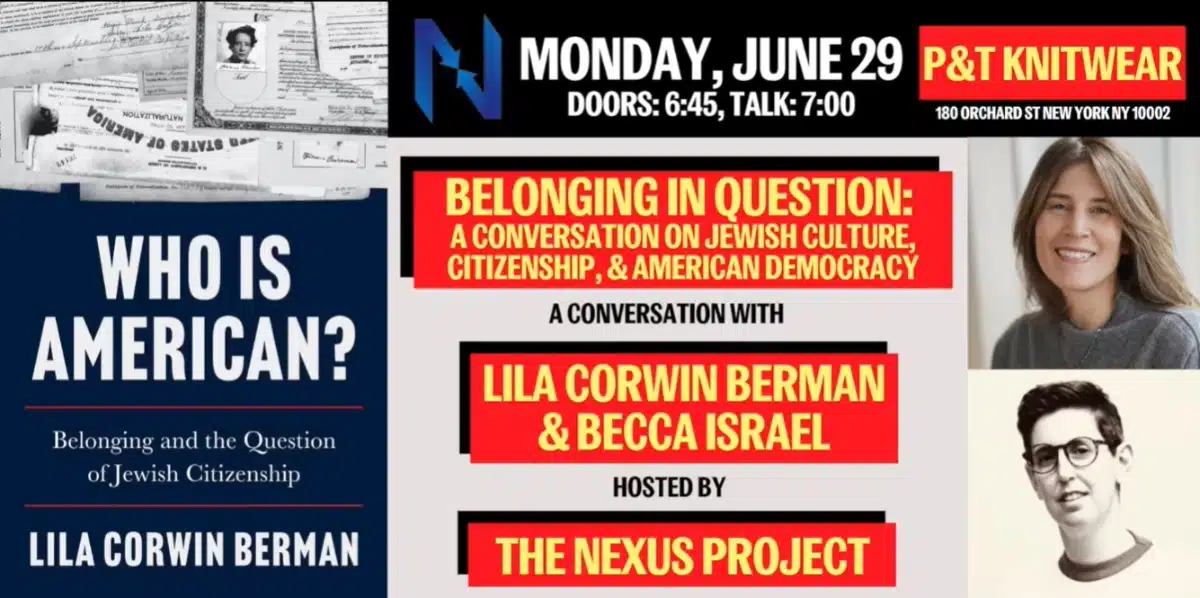
Panelists
- Lila Corwin Berman, Paul & Sylvia Steinberg Professor of American Jewish History at New York University
- Becca Israel, Vice President of Philanthropy and Strategic Engagement for The Nexus Project
Details
- Date: July 1, 2026
Hosted by The Nexus Project
Transcript
Recorded Live — Full Session
Becca Israel: So, first I want to just say a thank you to PNT for inviting us here tonight and for providing the space. and thank you to all of you for coming especially on a Monday night in the summer. It’s a big deal. so honored to have you here. and I know we’re all here because Lila is a real rock star. and I feel honored to be next to Lila.
Lila Corwin Berman: as you should.
Becca Israel: That’s right. That’s exactly right. but I do want to just set the tone. which is that we’re living in quite a unique moment, a moment of heightened antisemitism. And I think what’s really interesting about this moment in particular is that this moment has allowed so many people to argue about what is and isn’t antisemitism. And I think attached to that, what just makes the moment even more unique is that we have the administrative administration and so many others who are essentially basically weaponizing antisemitism and using antisemitism to strip away our democratic freedoms and safety.
So happy you’re here. It’s my wife, who you should all talk to. and I also think that this moment is really an opportunity to do something different. so what I want to do now is just talk about what this opportunity is and just tell you a little bit about who I am and what I’m doing at the Nexus Project. So I think the opportunity right now is really to build a path forward that leads to greater clarity, greater understanding and greater safety for all vulnerable communities to a place of better research, better legislation, better data so that we have a clear understanding of what anti-semitism is. and to really create a tangible future full of shared care and justice for all people. and that’s really why the Nexus Project was created.
The Nexus Project also I should just say I’m Becca Israel. I’m the vice president of strategic engagement at the Nexus Project. we’re an organization that’s focused on combating antisemitism and its weaponization. as well as protecting our democratic institution and safeguarding free speech. and so we do this work through three different channels. the first is through 501c3 political advocacy. which allows us to expose performative legislation. This is legislation that’s under the guise of protecting Jews and we know it’s actually antithetical and is actually harmful to American Jews and all vulnerable communities. And in this work, we also provide policy recommendations. Josh Berman, I’m looking at you to provide better policy to elected officials to strengthen their work on combating anti-semitism and ensuring there is shared safety for all vulnerable communities.
The second is public discourse. and this you know the all three channels are equally important but this second channel has had a huge impact. and this work is done through two different forms. One is through traditional media and one is done through social media. And I would say I just turned 40 and I like to think of myself as young so I’m just going to say I’m still like the next generation. I just need you to go with that for tonight. but this next generation really gets their news through social media. And so part of our work, it’s not calling out anti-semitism, but it’s really explaining the different forms of anti-semitism that we’re seeing. It’s educating people, giving them access to language and a template for how to actually really understand this moment is that is, as Lila’s going to talk about with her book, is so incredibly it’s so complex. and there’s so much emotion and trauma baked into it. And so we need to not fingerpoint but understand when we see and feel anti-semitism both from the left and the right.
We need to understand why it’s happening. Which leads me to the third channel of our work, which is research and scholarship. We recently deployed a new center on understanding anti-semitism in contemporary America. It’s really just a niche, but it is hyper important, which is really allowing us to dig deeper to really understand the what anti-semitism looks like and its different forms. I just want to highlight one example of the work that I think will help give just more color to this channel of work and I also feel like half the people, maybe 80% of the people in this room tonight went to Brandeise. so I feel like it is really just relevant. we just signed a contract with Brandeise University to do in partnership with them to understand slogans.
So in particular we want to understand when protesters say from the river to the sea, we actually want to understand like what do they mean? What are they talking about? And then on the opposite end of the spectrum, we want to understand how is it being perceived by different pockets of the American Jewish community. And we think by digging deeper and really having better data from our research, it will allow us welcome. There’s some reserve seats up front to do some better bridge building and to really engage in stronger relationships that will lead to a path forward. And then lastly, and this brings me to Lila, is the scholarship part of the of the work. we have an amazing team of 13.
It’s I promise you not a coincidence. academic experts like Lila who help craft materials for us that we then can deploy to journalists to Hill staffers, elected officials, rabbis, hille professionals, etc. So they have resources and materials and templates for how to actually understand this work. so talking about democracy, this feels like this is like the most timely conversation to be had, but your book is who is American is just it’s really powerful and I thank you for writing it. And I really want to just start with this one with the one question that I want you to throw out to people. And I think that is that is probably the best way to really kick this off. But thank you for being here.
Lila Corwin Berman: Well, thanks for inviting me. and I’m involved with Nexus and I will say that like to me one of the kind of ways that to me it proves kind of its highest standards is that it engages scholars who have disagreements, right? I think we would disagree with each other. I think sometimes we disagree with some of what Nexus says and it is open to that and to me like that is the hallmark of the kind of organization that we need now. so when I wrote this book, when I started to think about citizenship, I realized that I had come to kind of conceive a citizenship in a way very different from the way I grew up thinking about citizenship. I had the privilege of being a citizen of this country and kind of didn’t give it much thought beyond that. And so I actually wanted to start though because I think we are in a different moment.
How many people in this room, you don’t have to raise your hand, but you can have tried to get or have succeeded in getting a different citizenship over the let’s say last four to five years. How many people know someone who has? How many people have thought about doing so? Right? So I think we’re living in a moment that is really showing the ways in which citizenship is actually the legal terrain for how we think about and grapple with and understand what it means to belong, what inclusion means and what exclusion means at different moments in time and the way in which I kind of came to this topic was actually through a field through American Jewish history that had only understood citizenship as a kind of point of arrival, right?
That the narrative was, and I know we were going to sort of get into this, right? The narrative was that Jews had come to the United States. They had for many, you know, from many of the different places they had come, particularly in Europe, but other contexts as well, had always struggled to have that kind of political, legal, and civic belonging. And when they came here to this country, they were able to kind of be done with those battles, those struggles about emancipation, about citizenship, about belonging, and that was the end, right? And the question was over. And for me over the last five, ten years that basic narrative, that basic foundation of my field no longer felt convincing because I was living in a time when people around me and me myself was thinking about whether the citizenship I had in this country was the citizenship I needed to provide me with the security and the protection and living in a place that was secure and protecting other people And I was seeing an administration during the first Trump administration that was changing the ground of citizenship, was taking things that we thought, you know, we’re all waiting still for the Supreme Court to decide this birthright citizenship case, but it’s not just that. It’s changing the status of people who have certain kinds of protected status or certain kinds of documented status and saying that it’s different now.
So that led me to ask this kind of basic question which is had my field and had I misunderstanding citizenship that it wasn’t this kind of final destination point of arrival thing that sort of solved these questions but that it was constantly in question and that I think you know so many of us in this room are actually thinking about different citizenships right asking new questions of the citizenships that we may have sort of proves the point in a way that led me also to want to kind of excavate the history of this
Becca Israel: Yeah, I just want to build on that piece. like many of us grew up with this story of American Jewish arrival and security. I know I did. like what assumptions do you want most this audience to have into question about that story?
Lila Corwin Berman: Right. So, part of what I think is erroneous about that story is not to say that all the ways in which Jews felt secure or were able to gain certain forms of success in this country are wrong, right? That would be wrong, right? That’s simply not the case. What I wanted to really understand is how did the kind of legal form of belonging through citizenship, how was it changing over time? So, how were American state officials understanding Jews, slotting them into different kinds of categories, different types of citizens? How were they comparing them to other newcomers? So instead of saying that, well, you know, it’s an either or that like either Jews gained citizenship and therefore things were fine or they didn’t, it’s saying that this was this kind of constant relitigation of what it meant to belong.
So it’s not to say I mean I think it would be a completely you know sort of ill-founded conclusion to say oh Jews just you know had have always had a bad here and actually their citizenship has always been in question. The point is that the machinery, the architecture of assigning people, whoever they are, citizenship is constantly performing that mechanism of being able to kind of reask questions of how belong how people belong and who belongs.
Becca Israel: So this next question is like seems very obvious and it feels really important I ask you. which is like why does it matter that we have access to a plurality of Jewish stories? I think we just need to hear it.
Lila Corwin Berman: Right. Right. Well, I mean, you know, I think that part of that does that need to have lots of different kinds of narratives about how different sorts of Jews have navigated what it means to belong is also to understand that all sorts of other groups, right? like a fundamental finding, a fundamental thing I found in this book was the way that Jews status in the United States was always entangled with the status of others and that it would be impossible to make a claim just about Jews without also in a in a legal sense without also making a claim about other people. And actually, I sort of like came to this in an interesting almost reverse way. during the pandemic, I guess I have much to do.
It was couldn’t go to archives or whatever. And so I was reading a lot of legal cases because it’s you can just find them online, right? Like this is what academics do for fun. So I was reading these cases from the early 20th century when different groups of people had come to the United States from like the Ottoman Empire, from the Middle East, and had petitioned for citizenship. And some of these cases ended up before federal judges who had to decide whether the petitioner was white because under the laws of citizenship, one could either be white to gain citizenship or be of African descent or nativity. And if they were neither of those two things, then they could not be citizens. And this is there’s a legal scholar Ian Haney Lopez who’s written incredible work on this and he had cataloged a lot of these cases. So, I was like reading them and it turns out that this persistent thing happens in these cases as the judges are trying to decide, okay, they have an Armenian before them, they have a Syrian before them, whoever they have, and they’re trying to figure out.
So, some of them are like, well, he looks white to me, or some of them are like, you know what? What would the scientists say, right? One thing they do, and this is super common in law, is they make analogies. So they say, “Okay, I don’t have a case where there was someone from Syria who I definitely know got citizenship or didn’t get citizenship or whatever the case might be, but I know what people say about other groups.” And so they started making this kind of Jewish comparison saying, “Okay.” And in the language of the day, they say, “Well, Hebrews I know are citizens in this country, right?” And they, you know, find different evidence that they know. You know, there’s this one judge from Boston who’s like a Boston Brahman type, right? Lol. And he says, “Well, you know, some of my best friends I know are Jews who are citizens and yet on what ground could Hebrew, you know, constitute a white person?” And what he actually he goes to his books and everything else and he actually says on no ground, this is a loophole.
Actually, Hebrew never should have become a citizen given what he sees as the authoritative texts of the day, right? which is proving just how much these categories can shift. So he goes to those authoritative texts and he says no like a Hebrew which I’ve decided is analogous to these Iranian petitioners before me even though I know Hebrews have citizenship they shouldn’t it’s a loophole and then he says okay but like how can we allow this extraordinary exception this is what he says in his opinion and not kind of you know give the same possibility to other extraordinary groups who are sort of questionable. So fine, the Armenians can have citizenship, but Congress, you do your job and you make it clear whether you want not just Armenians, but Hebrews as well to be citizens. Right? Now, does this mean that like, oh, you know, Jews were struggling more or in different ways than other groups? That would be absolutely the wrong lesson to learn from it. Right? The lesson is to see how entangled the different questions about status when you have a system.
Even though it’s meant to be delivering individual rights, its thresholds are based on these categories. And where Jews fit becomes often a kind of stress test or a way of defining, clarifying, and often redefining the categories.
Becca Israel: Yeah. wow. Can you just talk more about some of these categories in your book? I feel like I want you to draw that out more. Share like a few more examples.
Lila Corwin Berman: Yeah. So, I mean, race, right? What people category of race is one of the really important ones under law. And the way I kind of structured the book is I talk about how that category is deployed at the early 20th century and then the ways at the end of the 20th century and into our own moment that race becomes sort of redeployed as a category of citizenship and rights, right? And so looking at stuff that many of us now know about title six and ideas about whether Jews can be part of these categories that are specified in anti-discrimination law. but religion also is an important category for thinking about citizenship and thinking about the rights of citizens. nationality is another category.
There’s a bunch of really interesting cases about how you classify right when immigration restriction legislation was thinking about how to define those categories of people who were less desirable in the United States. Right? Initially Jews were classified as Hebrews, right? And that was a kind of way in which although you know you might have French, you might have German and other groups, Jews were sort of designated separately and Jews end up advocating to say no, you should not classify us separately.
They see that as very dangerous and instead we should be classified, they say as part of the nationality that we’re from, right? And so this becomes a sort of sense, oh well, you know, maybe the best way to think about a Jew as a Jew is a French person or German person or wherever they’re from. And then with the rise of Zionism and Jews going to Palestine as part of the sort of nent political Zionism and then settling in Israel after its state, questions start to arise about whether if there is this thing called Jewish nationality.
Does that sort of mean that Jews always have the potential to have this other citizenship and at the time in the 40s 50s60s there wasn’t the legal architecture of dual citizenship, right? So this raises all these questions as well about like what it means to have you know decided that the right category would be maybe nationality right or at the same time others arguing no the right category to understand Jews is religion and nothing other than religion right and so it’s important that it’s like both how American law and officials from the American states see Jews and also Jews as agents kind of making claims about where they fit in these categories.
Becca Israel: Yeah. Wow. I want to talk about like the slash for like the future of American jewelry and like sort of what you talk about of who gets included, who gets excluded and how does the question of belonging shape the future of Jewish life in America just it’s a casual question.
Lila Corwin Berman: It is a big question. Well, so I mean I’ll answer that really obliquely, but you can ask me, you know, more direct pieces of it, but I think that part of what I found myself thinking about as I was doing this research is that in a sense like these different categories and all of the sort of debate about where to slot Jews into these categories and what they mean, you know, whether for the purposes of law, for the purposes of inclusion, exclusion, whatever the case may be, like these are about the arguments and the terms of what it means to belong.
So there is this sort of sense and I feel it now right that like Jewish organizations Jewish institutions believe it’s really important to be able to say Jews are this right like especially in conversations about Zionism right the desire to sort of like pin this down to make it stable and then to say the law has to see Jews as this so it can protect them right but in a sense what seemed to be like the most successful way of living in the kind of constant interrogation of being a citizen is always to see the categories as nothing more than an argument and I think that there’s a tendency to try to like find one you know be like well there should be an answer like what are Jews are they a race are they a nationality are they a religion and you know there are people who will give you the answer and in a sense that undermines like that the desire to sort of stabilize Jews in this category kind undermines the argument and that’s all these categories are about like they’re not in essence and they’re constantly changing they’re fickle and they’re strategies and you know so in my own perspective I think the right strategy is to use them to build relationships with other groups of people and unfortunately I see certain institutions doing the opposite which is a strategy as well to use the categories to destroy relationships Right.
It’s a strategy, and that conversation of the categories, by the way, is still happening. Are Jews we a race, etc. It’s not helpful. Becca Israel:
yeah. I want to like in the book you said that the future depends on a multi-racial democracy. how can questions of citizenship help us understand that more clearly?
Lila Corwin Berman: Well, I mean, I think It’s so the first thing is it’s not like necessarily that citizenship is going to lead to that, right? And I think like if we have faith in the you know well once you’re an American citizen like this is what it gives you. This is how you’re protected. and therefore, you know, if it means well we don’t want those people to be citizens and we want to exclude, you know, all of these different groups because I’m going to hold on to my own citizenship, right? Like I understand how you might perceive that as a strategy of kind of like holding on to a thing that you want to protect and that you could see as scarce. But what I feel like is often sort of missing is understanding that when you know when there’s an argument made to exclude any particular group, that argument has legs to exclude lots of other groups.
Becca Israel: Yeah.
Lila Corwin Berman: Right. And it I mean it doesn’t necessarily mean that therefore every group going to be excluded, right? But like it’s been surprising and alarming to me that I don’t hear from Jewish communal organizations much discussion about this birthright citizenship stuff,
Becca Israel: Right? And you know, and that might be because many think, well, you know, this would not really affect Jews. We have other fish to fry, whatever,
Lila Corwin Berman: But like it will, right? you know, I mean, changing the like very basis of understanding what it means to be a citizen here and sort of rolling back what the 14th amendment was that’s going to change the system and that will change for everybody. And so I think like there’s no nor citizenship doesn’t necessarily guarantee anything, right?
Becca Israel: But it does create occasions for relationships with other groups of people. I’m just thinking a lot about like what do we do with uncertainty? That’s like really what I’m thinking a lot about. if citizenship law is better at posing the question of belonging than answering it, what should American Jews and Jewish institutions do with that uncertainty right now?
Lila Corwin Berman: Well, I’m probably not the one to answer that. that you know that’s I can sort of hide behind being the scholar or whatever. so maybe I can do that a little bit. But I guess like one thing I would say is I actually see a lot of Jewish organizations now hiding behind law, right? And making these kinds of claims like, well, you know, Jews have been excluded from the protections of anti-discrimination law or, you know, Jews have to go to the courts to fight and make sure that their rights are protected when they’re, you know, being degraded in this way or that way. and so they’re kind of working through that system of the categories of what it means to be a citizen and what it means to have particular kinds of rights.
Becca Israel: and I understand that impulse and that’s been like a building, you know, that was something that was built out in the 20th century like Jews really tended toward law as I would argue their political strategy. So it’s not surprising. but always underneath it are human questions, right? Are the question of like what do we want, right? What kind of shared society or not shared society do we want? Because the law can follow, right?
It can be crafted in multiple ways and it has been right like you know there was a time right when because I’m a woman if I married a man who had been foreign born I would have lost any rights to American citizenship and then that stopped being the law and it changed right there was a time that if you were a naturalized citizen and you spent more than five years living abroad somewhere you potentially would be forcibly expatriated. You would lose your citizenship. And then that law changed, right? There was a time where if you was were somebody who you know had dreamer status, then that meant that you could feel pretty strong about having certain protections and that has changed, right?
There was a time if you were somebody who applied for asylum, it was more likely than not that you would get it. And now no more than 10% of the people who apply for asylum in this country get it. So these things can change. And if you think that like the answer is just to go hard into law and you can’t be plain about what the actual human values you care about that are motivating you, I think you kind of lose your soul.
Lila Corwin Berman: Yeah. I’m just I’m taking everything that you’re saying. when you finished writing the book and you thought about what you’re most proud of and what you want people to take away from the book, are there what kinds of questions, think about like two questions you want people to really struggle with after reading this book?
Becca Israel: Oh my god, that’s I cannot like tell you what I’m most proud of. Can anyone answer that question about like your work? No, I mean I
Lila Corwin Berman: I have such a visceral reaction. All right, but like what are two questions? What are two questions like that you want people to take away?
Becca Israel: No, it’s a fair. It’s just me.
Lila Corwin Berman: No, I mean if you I don’t talk. Who doesn’t have imposters?
Becca Israel: I’m proud of my children. Okay.
Lila Corwin Berman: So two questions. I mean, I think that like the questions of how do we use this moment, which I think is fair to say has been a horrible can moments be the has been perfect or whatever, like it is an enduringly horrible moment that we’re living in. like how can we use that to ask new questions about building stronger relationships with different groups of people and doing so in a way that gives more and more people the benefit of the doubt and that treats the resources that we have not as scarcity but as shared ideas. that’s like preaching in the form of a question I think but I you know like I think it’s really about like what are the stories we can tell what are the ways of seeing like you asked why is it important to have lots of different stories about Jews and I think the reason it’s important to have lots of different stories about lots of different people is because when we see those stories like there’s a point in which we see ourselves like we’re not going to see ourselves in every single story that someone’s telling and that’s okay.
Like we should appreciate the differences too. But, you know, for groups who are not us, for groups that, you know, maybe have been demonized in certain ways or that there’s tension, like the more that we can appreciate the different struggles and the different stories and not feel like there’s a scarcity of compassion for that, like the more we’re going to find ways to build those relationships and not let sort of the dictates of, you know, what the law might say to limit the playing field, but actually first decide what field we want to play in and then create the laws and the structures to try to get there.
Becca Israel: Thank you. and I had Lila sign my copy of the book, which you can buy over to the right to my children. these questions are really hard. but it’s a privilege to be able to have access to understand the history and some of these questions. so I’m going to open up now for questions. just Yeah, go ahead.
Lila Corwin Berman: Yeah, that’s a great so one of the trends that I trace in the book is like in the postw World War II period this desire that especially among Jewish lawyers is really like building to use the first amendment and the protections of religion. So both the freedom of religion and also the kind of separation of church and state so anti-establishment to create like a protected space for Jews. And part of that involves defining Jews more and more into that kind of language of religion. And so that’s simultaneously trying to kind of expand the imagination of let’s say in this case the American courts of what religion is.
It’s also a certain kind of narrowing of kind of fitting Jewishness into those categories of what religion is. and you know most I would say like the real majority of Jewish legal energy in that period after World War II is about church state law and is very much about trying to you know this is when you have cases about release time. So kids who would be in public schools who would get busted to some kind of religious school or the religious school would come into the public school and teach catechism or teach whatever you know kind of Sunday school type curriculum in the school. Was that constitutional? You had school prayer. You had Bible readings. you had questions about whether on the other hand you know days off should be given for religious observance. you had questions about whether people who were imprisoned should have the right to have their different religious obligations met.
So all of those different questions about not just like what is religion but when we decide what religion is what is the obligation of the state to it and what is the obligation of the state to be removed from it right and this becomes like the arena where so much work is being done by Jewish lawyers who are tied into Jewish organizations to try to kind of you know both protect what they see as like the fundamental need the separation of church and state and somehow also protect the very contradictory thing which is making sure that the state provides protections for people to be free to live out their sincerely held religious beliefs and at the kind of root of that is the extent to which there’s a basic Christian presumption of what the norm of religion is and I think we see that shifting back and forth over the 20th century and I think you’re absolutely right that we’re in a period where the idea of the standard of what a sincerely held religious belief is seems to be kind of very much cleaving to a sort of Christian normative view of that and therefore all of that precedent of the kinds of protections becomes kind of dangerous, right?
Like this is part of the shifting I think I wouldn’t like spend my days involved in that political fight, but I would intellectually think about the ways in which these, you know, because there was a point when there really wasn’t a legal framework of dual citizenship. So there’s a case in 1967 about a Jewish naturalized American citizen who spent time in Israel, voted in the Knesset in the parliament election and was forcibly expatriated because of it. It ends up before the Supreme Court and at that point there’s the appetite to say well maybe this is okay that people can have these different kinds of allegiances and we could talk more about that.
But the fact that the laws themselves changed and that had everything to do with geopolitics, right, the chief justice at the time, Earl Warren, really loved Israel. He understood it as in his terms a pilot plant for democracy. So it made perfect sense that he was very sympathetic to that case. I think it’s something that we should understand has the potential energy to change, right? And again, like that doesn’t mean that then you live your life in this kind of heightened state of insular fear, right? And you sort of like wall yourself off.
I think what it means is you try to build those relationships and those coalitions so that you have people who care about protecting your status and you protect other people’s status even when you don’t feel that something is happening to them is necessarily going to affect you. But it’s I mean, you know, Trump has more than once told American Jews that he’s protecting their country and he’s not talking about the United States, right? So I you know, it’s isolationism is a time when the idea of dual citizenships would be questioned, right?
Becca Israel: Yeah. Go ahead. Lila again. Yeah.
Lila Corwin Berman: Yeah. I mean, I think that these things are linked, right? And I mean, but it’s not always linear either, right? I mean, because you have Jews who become sort of enamored with certain ideas of exclusion as well, right? And certain ideas of, you know, I mean, one of the topics I deal with in the book has to do with the with affirmative action, right? And the actually the earliest case about affirmative action in higher education involved a Jewish guy who had applied to a law school at the at the University of Washington. This was before Baky Bak. Yeah, this is Defunis. And this is the first case that reaches the Supreme Court about affirmative action in higher education. And different Jewish organizations kind of peel off in different ways supporting either his petition, which is that the university should not be allowed to prioritize certain groups for admission and others are supporting the university.
One of the groups that supports the university and says, “No, affirmative action is fine given the history of exclusion that African-Americans and other minority groups have faced is the National Council of Jewish Women.” And they join an amicus brief with the Children’s Defense Fund, a bunch of labor organizations, and black civil rights groups. And it’s, you know, this really interesting brief that they write. the American Jewish Congress Committee and ADL go on the other side. And what’s interesting is the letters that the National Council of Jewish Women, which are in the Library of Congress, get, right? Well, I guess I should tell my son he can stop studying because some X, Y, and Z, is going to take his place. And you know, yeah, like I feel like, oh, what an awful person. But also understanding again the ways in which this idea a certain scarcity, right?
That rights are scarce, that there has to be this kind of competition for them, you know, like how baked in that becomes, especially at that moment in the 1970s, right, when these cases are starting. So, you know, what I would say is like, yes, absolutely, racism, anti-semitism, these things sort of feed on many similar impulses and they degrade democratic institutions, but it doesn’t mean like that fact, pointing out that fact somehow doesn’t actually necessarily bring like the better angels in everyone. Totally. And in fact, just to go back because I already gave the setup of that Defunas case, the affirmative action case, the other Jewish organization that signs the same brief as the National Council of Jewish Women is the Union of American Hebrew Congregations.
The reform organization and I was interested in trying to understand like why they did that and I eventually found some correspondence where the guy who had really pushed for it said you know I wasn’t actually sure what the right thing to do was but what I saw was that all of the big players of Jewish organizations were sort of lining up against the people I felt like were really important to be our allies and so I made the decision that we were going to support those allies, right, that we were gonna we were going to work with them and you know, you can sign a brief and you can be involved in that and you don’t have to like agree on every single thing, but that as a matter of strategy, it is important not to cut ourselves off and you know if that means that like you know down the road a couple of Jewish kids don’t get into this school or that school like we’ll live you know and that was like so he’s like very clearly articulating that.
And then in those early 20th century cases when Jews become this sort of comparison, lawyers like Kohler, in fact, Max Coler and other early 20th century lawyers engage as either, you know, offering their services as attorneys for these non-Jewish petitioners who are running into this persistent question of if they’re white for the purposes of citizenship. And like you could say, well, they’re, you know, they’re sort of doing it because they want to control the comparison. They don’t want judges to sort of keep saying, “Well, Hebrews aren’t right, aren’t white, and you know, come on, Congress.” So, like, yeah, there’s self-interest perhaps in it, but they end up like some of them end up, you know, representing a whole class of Syrian interveners in these cases and really building a strong relationship with those other kinds of communities. So, you know, these two things like Yeah, there’s a strategy definitely and it builds these kinds of relationships,
Becca Israel: Right? Exactly. I think we have time for one more question.
Lila Corwin Berman: Yeah. I mean, I think that this is like kind of the heart of where so much of this lands us. and you know, again, that’s where I think we have to ask like what is the actual value that we want out of this. So, is it enough to say, well, the value is like I don’t want a Jewish person in this country ever to feel uncomfortable or to feel like they might walk into a situation where they are challenged in such a way that like they might not feel like they’re totally accepted or is the goal to say like it’s really important that we have as kind of robust protections as possible for you know the kinds of speech and the kinds of debate that may make certain people uncomfortable but that if we criminalize that right and which you know what you see I think under the Trump administration is the move from first of all like defining a whole bunch of speech as antisemitic okay fine and that then happens under civil law under civil rights law to then pulling that into criminal law and if Jews can’t call that out then I think we’re really in a position where we’re going to be allow allowing ourselves one to be used to hurt other people and two I think it does ultimately harm the ability of Jews actually to be safe.
So you know that the way in which a certain kind of initial delusion I would say of oh this is going to ultimately I mean we talk about this when we talk also about security right and security guards and all this stuff that like there’s you know one has to sort of think about like who is this protecting and who is this not protecting and it doesn’t mean then you therefore say well you never need security and I don’t think it means that you say well therefore Jews ever need you need to have civil rights protections, but it means being really vigilant about not letting those protections turn into the ground for actual criminalization of speech and of behavior and if Jews aren’t calling that out and I guess to like circle us back to Nexus, one of the reasons that I have been involved in Nexus and I support what it does and over taught about some of Nexus’s materials at my own congregation in Philadelphia is because Nexus is not pulling its punches about that, right?
Like Nexus is really clear about saying if you’re calling something out as anti-semitism and that then is becoming pretext for harming other groups of people, then you’re not doing it right. So that’s I think what I really appreciate about Nexus.
Becca Israel: Thank you. Well Lila and I will be here for the next all night to answer questions. but thank you so much and this book is really meaty, really good and you should check it out. Thank you all.