
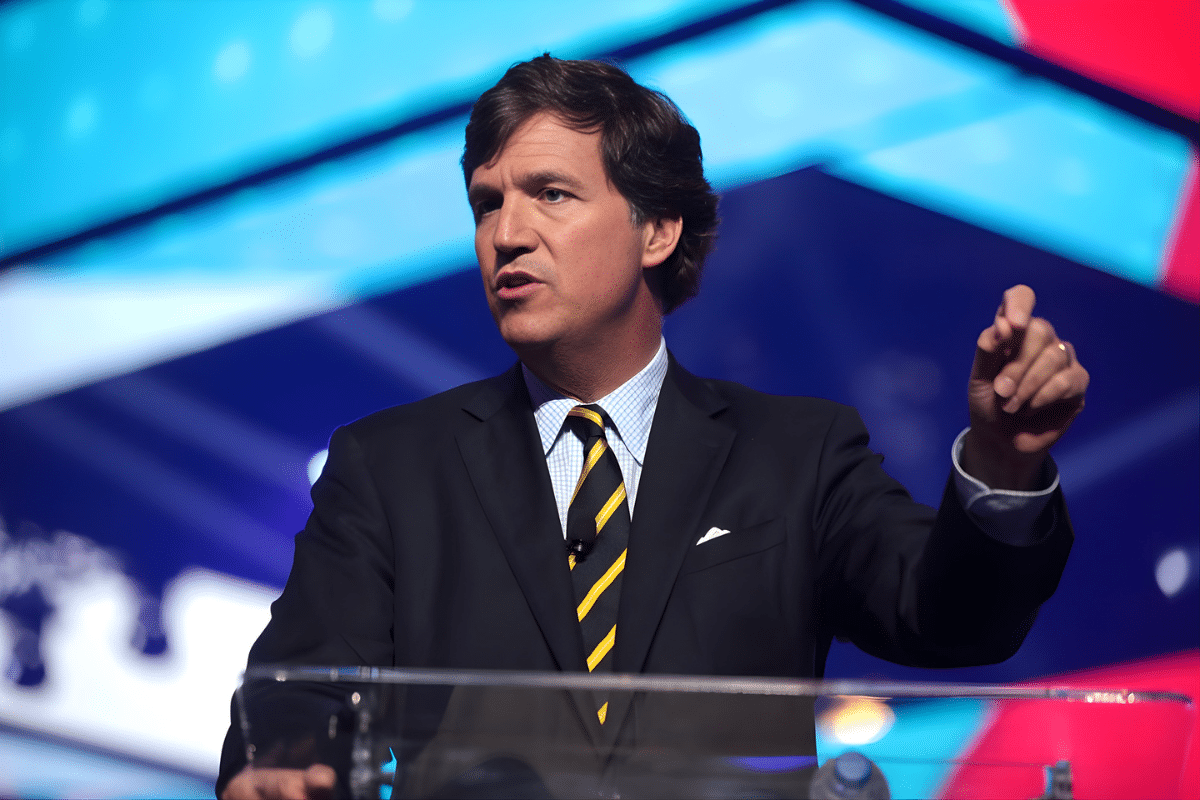
Tucker Carlson has emerged as one of the most vociferous voices against the Iran war on the right. Since President Trump ordered military strikes in February 2026, Carlson has led a small but highly visible faction of conservative media figures in characterizing the conflict as “disgusting and evil” and framing it explicitly as “Israel’s war.”
Some observers have painted dramatic portraits of a MAGA coalition cracking over the Iran issue, with Carlson leading a resurgent non-interventionist wing that could fracture Trump’s political base. Some have also suggested that Carlson’s leadership on this issue could inject more antisemitism into a larger portion of the conservative world. More on that later.
Enter a new poll from JL Partners, released to the New York Post on March 19, which appears to settle the question decisively: Carlson’s influence is marginal at best. The survey of 1,018 “likely Republican voters” found that 83% trust President Trump on Iran policy compared to just 6% who trust Tucker Carlson and Megyn Kelly. When asked whether a candidate aligned with Carlson’s “Israel’s war” position would gain their support, 55% said they’d be less likely to vote for that candidate.
Media outlets have taken this report at face value. The New York Post announced that “reports of Republican divisions have been greatly exaggerated.” Jewish Insider went further, declaring that Republican voters “reject Tucker Carlson.” For those of us who are concerned about the spread of antisemitism, that conclusion sounds reassuring. We accept this narrative at our peril.
The survey, which lacks a methodology statement, states that it focuses on “likely Republican voters.” What does that mean? According to the survey’s crosstabs, two-thirds of these voters are over fifty years old. A bit less than half get their news predominantly from Fox News or other cable TV.
This may or may not be a good approximation of reliable Trump voters. But is this a good representation of Tucker Carlson’s base?
That’s questionable, perhaps most importantly because there are indications that Carlson is most popular among younger voters. The Yale Youth Poll, fielded in October–November 2025, found that the youngest age cohort (18-22 years old) preferred Tucker Carlson to any other potential Republican 2028 presidential nominee besides J.D. Vance (other than Donald Trump, if he ran for a hypothetical third term). A November 2025 Rasmussen survey similarly found that Carlson’s favorability among all likely voters is net positive only among those under 40. These are precisely the voters who are hardest to find in the JL Partners sample.
And even within the JL Partners sample, one statistic stands out: True, 55% said they would be less likely to support a candidate who shared Carlson’s view that the Iran conflict is “disgusting and evil” and “Israel’s war.” But 19% of these likely Republican voters said they would be more inclined to support such a candidate, even if that meant breaking with President Trump. Carlson’s message has a constituency.
Tucker Carlson is one of the most important enablers of antisemitism in the United States today. He is not as explicit about it as Candace Owens or Nick Fuentes. But day after day he pushes a narrative we have seen before: Jews manipulate governments, they hold non-Jewish life cheap, they push countries into war in order to advance their own interests.
Carlson substitutes the words ”Israel” and “Zionists” for “Jews,” but let’s not pretend this is innocent geopolitical analysis. Other commentators have found ways of discussing the U.S. and Israel’s complex relationship in this difficult moment without reaching for these antisemitic framings.
Carlson has chosen a different path, and in doing so has become a leading voice in priming millions of Americans to accept antisemitic concepts at a greater rate than at any time since the days of Henry Ford and Father Coughlin. Treating this poll as proof that Tucker Carlson doesn’t matter ignores the audiences, especially younger people, who are steadily internalizing his dangerous worldview.